Such a Small Country
Yeterday at a function I met a well-educated gentleman. Turned out that he worked close to a cousin (someone whose intellect I respect immensely.) I asked my new acquaintance if he knew my cousin. Of course, he said, he has been there for many years. Suddenly he asked, "So are you from Sylhet too?" When I nodded, his eyes narrowed for a fraction of a second- I could almost see some thoughts go across his mind - and the conversation somehow ended quickly.
Now, perhaps he had other people to talk to, and my Sylhetiness had nothing to do with it, but I find that for a country so small, Bangladeshis are ridiculously provincial. "Desh", the Bangla word for country, also means "village home." Often people will ask me "Where is your Desh?" when they mean "Which region of Bangladesh are you from?" "Oh yeah, my Desh is Sylhet, only 35 miles from your Desh of Brahman Baria!" Right.
Then there are the inevitable stereotypes. Tangail, Barisal, Chittagong, Noakhali, Sylhet - we all love to wrap them in unsavory flavors. One day I was going somewhere with a friend who did not know my driver was from Mymensingh. He went on for a few minutes about how stupid, idiotic, moronic Mymensinghis are (I think he was trying to contrast them to the people of the district we were visiting, who he thought were very smart.) To his credit my driver kept quiet. About ten minutes later, when I asked my driver a question, he answered with an ultra-thick Mymesinghi accent - so thick that my friend understood and went red.
All this geographical stereotyping reminds me of my good friend Sanjiv who years ago worked at Siemens. After a reorganization, Sanjiv inherited a new boss. The first question the boss asked Sanjiv was "Are you from India?" Sanjiv's "Yes" caused a flicker of unhappiness to pass through the boss's face. Thus began a very difficult relationship, with boss making Sanjiv's life hell. Eventually Sanjiv moved to another group.
Some time later, Sanjiv found the real story. Years ago, the boss's wife had run off with an Indian man!
How to Play Dad's Basketball...
...with your son's High School Basketball Team.
Since you are one of only two Dads playing, your goal is to play better than the other Dad, not the other High School boys. If the other Dad is in your team, don't give him any good passes. If he is in the opposite team, guard him with all your life.
Give it everything you got until you make one basket. Then you can relax. The perceived difference between the Dad who scores no basket and the Dad who scores even one is huge. Well, to you, anyways. The kids probably wonder how you made that one basket.
The traditional pass-and-cut move, where you pass the ball to your teammate and cut under the basket very quickly as he passes back to you and you shoot, is for kids and sissies. Real Daddy basketballers prefer the more mature move of pass-and-stand. In this move, you pass the ball and keep standing. The passee has to dribble and find a way to score the basket.
At your age, you should know the meaning of triage. Apply triage mercilessly. That means, before making a dash to make a layup or another dash to stop that fast-break, consider how much stamina you have left, and your chances of being successful or looking like a fool. With enough triage, you can play a very relaxed game.
Along the same line, save your stamina for one or two really fast moves, when the teenager guarding you has written you off as a total lame duck because you are panting half the time. Then, when you actually get a pass, dribble around him. He will be so surprised that you will probably get a free shot at the basket. Take care to make this shot, since this is last and only chance.
Never keep track of the score. At your age, it is enough that you run with the teenagers and get to touch the ball a couple of times during the game. Remember, the joy of winning must be great, but the joy of participating is even greater.
Best of all, when your son makes an effortless basket over your head while you are trying to guard him, don't get mad at him. Be proud that he is your son.
E. B. White and Brevity (with some Mujtaba)
The other day I was invited to a gala dinner event. Towards the end of a most inspiring evening, and just before the dinner, the Chief Guest delivered his speech. Trouble was, it was a long delivery: we all felt the labor pains. At one point, he said "And I now digress to say that..." and the young man sitting next to me groaned, "Oh no, please please don't digress!" I felt bad for the CG, who, in his seriousness, had forgotten he was the last thing that stood between the audience and its dinner. He should have listened to E. B. White and Will Strunk's timeless advice: "Omit Needless Words."
Somehow in our cultural makeup, specially when using English, we just love to pile in the words. "With humble submission I beg to state that" was what the Brits taught the Indians to start letters with. That is gone, but now in its place, I once gave a speech to an august body in Rajshahi that started like this: "Distinguished Mayor of Rajshahi, Honored City Council Members, Respected representatives of XYZ Furrin Organization, Highly Regarded Members of Parliament and the rest of you riffraffs I mean honored ladies and gentlemen." Once was enough, never again I swore. [Ok, ok, I didn't really say riffraffs - just checking if you are paying attention.]
Ok, so what's the connection between verbosity in Bangladesh and an American writer? Simple: White's lessons and examples, if followed, would result in more precise and effective use of English words in our culture. Here is an introduction to his works and lessons.
Elwyn Brooks White (1899-1985) is best remembered for his essays, poems and sketches. He also wrote the classic children's stories Stuart Little and Charlotte's Web. With Will Strunk Jr, White was the co-author of The Elements of Style, a guidebook for writing well.
White’s essays are infused with a profound civility and respect for nature. A master of writing style, he was a persuasive champion of plain and direct writing. A gentle humor permeated his words.
Take, for example, his essay Riposte, where he discusses a recently published article, The Meaning of Brown Eggs, written by an Englishman. White is not pleased with the article’s attempt to categorize Americans based on their preference for white eggs over brown. "Why is it, do you suppose, that an Englishman is unhappy until he has explained America?" he asks, arguing, "... but one seldom meets an American who is all tensed up because he has yet to explain England."
At the end of A Listener’s Guide to the Birds, a poem describing various bird sounds, White signs his name in bird-watcher terms:
"E. B. WHITE (gray cheeks,
inconspicuous eye-ring,
frequents bars and glades)"
Or take the start of The World of Tomorrow, an essay on the World’s Fair in New York,: "I wasn't really prepared for the World's Fair last week, and it certainly wasn't prepared for me. Between the two of us there was considerable of a mixup."
I first encountered White's work in 1977, when I entered Cornell University, New York, as a freshman. To my dismay I discovered that all freshmen were required to take a full year of English writing classes. I thought this was a waste of time since I knew all there was to know about writing. After all, hadn’t I earned an “A” in O-Level English? The first essay I wrote for my class proved me wrong. My typewritten paper came back from the teacher covered with red (outright mistakes) and blue (suggestions for improvement) marks.
I was humbled. A friend saw my predicament and brought me The Elements of Style. Not since Class 3, when my father gave me a crash-course in English grammar, had I learned so much about writing in such a short time. Soon my run-on sentences stopped running, my modifiers stopped dangling and my infinitives were joined: I made it through the writing class.
That was in 1977. Since then, this little book - originally written by Strunk, then revised and updated by White – has been my constant companion. With twenty-two precise and clear rules of English grammar and an inspiring essay on writing style, it has shaped my thinking and helped me communicate my ideas clearly .
Some of these rules yield direct, forceful words. For example, using Rule 16, “Put Statements in Positive Form”, we write, “He usually came late” instead of “He was not very often on time.” Rule 15, “Use the active voice”, exhorts us to change, for example, “My first visit to Boston will always be remembered by me” into “I shall always remember my first visit to Boston.”
Other rules dispel confusions of grammar. Rule 1, “Follow the possessive singular of nouns by adding ‘s” is followed by examples “Charles’s tonsils”, “Burns’s poems”, and “the witch’s malice.” I also find Rule 10 useful: “Use the proper case of pronoun.” This rule lets me write “Will Jane or he be hired?” instead of “Will Jane or him be hired?”
An important theme in The Elements of Style is Rule No. 17, "Omit needless words." I let the book elaborate: "Vigorous writing is concise. A sentence should contain no unnecessary words, a paragraph no unnecessary sentences, for the same reason that a drawing should have no unnecessary lines and a machine no unnecessary parts. This requires not that the writer make all his sentences short, or that he avoid all detail and treat his subjects in only in outline, but that every word tell."
What a beautiful world it would indeed be if all needless words were omitted! What would the politicians say? Or all those people yakking on their mobile phones? And wouldn't Bollywood have to shorten all its movies to five minutes?
In addition to being influenced by Strunk's thoughts on brevity, White was also a fan of the American philosopher and writer Henry David Thoreau. Having built a house near a pond in Walden, Massachusetts, Thoreau had lived there, alone, for several seasons, sustaining himself with food he himself grew. The book Walden, which Thoreau wrote during this sojourn, remains a classic of philosophy and simple living.
White had read Thoreau's Walden so many times that he had memorized parts of it. He even thought that Walden's Table of Contents, wherein eighteen chapters are named using thirty nine words, was a lesson in brevity.
In the essay The Retort Transcendental, White speculated on how he could quote from Walden in answer to common questions.
For example, if he ran into a friend after a long time, and was asked, "Where have you been all this time?" White would reply, "If a man does not keep pace with his companions perhaps it is because he hears a different drummer." Or if he walks into a restaurant alone during a busy hour, and the headwaiter - unhappy about one person perhaps taking up a whole table - asks accusingly "All alone?" the proper Waldenian response is, "I feel it wholesome to be alone the greater part of the time. To be in company, even with the best, is soon wearisome and dissipating."
But even Thoreau is not immune from White’s humorous prodding. In A Slight Sound of Evening, an essay discussing Walden, White writes: “Thoreau said he required of every writer, first and last, a simple and sincere account of his own life. Having delivered himself of this chesty dictum, he proceeded to ignore it.”
Born in 1899, White attended Cornell from 1917 to 1921. During his senior year he was the chief editor of the college newspaper Cornell Daily Sun. Most of his professional life was spent working for the New Yorker and Harper's magazines. In 1937, he bought a farm in Maine and lived there with his family. He then split his time between writing and farming. Many of his essays have real-life, touching descriptions of his experiences with nature and animals at his farm.
Here is an example from his essay A Report in Spring: "No rain has fallen in several weeks. The gardens are dry, the road to the shore is dusty. The ditches, which in May are usually swollen to bursting, are no more than a summer trickle. Trout fishermen are not allowed on the streams; pond fishing from a boat is still permissible. The landscape is lovely to behold, but the hot, dry wind carries the smell of trouble." I don't know about you, but reading this I can feel the crackle of dry air on my skin.
While White covered many genres, for me he belongs squarely in the canon of nature writing, the crown jewel of American literature. Molded by America's pioneer spirit, wide open spaces and magnificent mountains and prairies, the writers of this genre - Thoreau, John Muir, Peter Matthiessen, Aldo Leopold, Edward Abbey, John McPhee, Barry Lopez and others – spent much time in the American wilderness and wrote about their experiences in a way that was both universal and personal.
White’s essays are powerful because they ring true, since they are borne out of his lived experience. But what makes them enjoyable is his way with words. As another American humorist James Thurber said, “No one can write a sentence like White.” And in the heart of White’s crisp sentences was his passion for brevity.
This love-affair with brevity has universal parallels, of course. The notion that a well-crafted creative work contains no more and no less than what is necessary to express the artist’s vision is an old one.
Shakespeare excelled in precise and parsimonious use of words, lending punch to his writing. That is why we find it so easy, even after 400 years, to use one of his phrases to express a complex or subtle notion.
Tagore's songs are masterpieces because they have exactly the right number of words and notes: no more, no less. That's one reason they have the power to move us without being sentimental or maudlin.
The great classical composers, such as Mozart and Beethoven, also wrote their music in the same way. In the movie Amadeus, based on Mozart’s life, there is an exchange between Mozart and his benefactor, the pompous Emperor Joseph II. Mozart plays a piece he has just composed for the Emperor. The Emperor likes it, but since he is Emperor, he feels he must find a fault. “It has too many notes,” he says, “Cut a few”. The precocious Mozart quickly retorts, “Then which notes would your Majesty like me to cut?” For this the Emperor has no good answer.
Our own master stylist, Dr. Syed Mujtaba Ali, was also a proponent of brevity. In an essay on Bangali food habits, he says that our dinner parties serve too many dishes. When he complains the host, the usual reply is, “We did not know which dish you would like, so eat the one you like most.”
But that probably means the host does not know what his or her masterpiece is. "Does a novelist write a novel with five different endings and let you choose the one you want?” asks an exasperated Mujtaba.
Brevity adds another dimension to the well-executed creative work: we enjoy it without feeling the load of the artist’s hard work behind it. The artist or writer may have had to struggle and revise many times, but what we enjoy is the final, polished work, looking effortless. For example, when we see an Olympic diver, we marvel at his grace, though he never overtly reminds us of the years of hard work he has invested in preparing for this moment.
So it is with White’s work. A few sentences into one of White’s essays, my mind is usually filled with joy, hope, and a sense of well-being. But White was a generous craftsman: for those who want to create like him, he left instructions.
Extra! Extra! Goodbye Bangladesh!
Words on the street:
---------
Hawker selling newspapers: "[In English] Goodbye Bangladesh. Goodbye Bangladesh. Sheikh Hasina going to the America. In Bangla] Case being prepared against Khaleda Zia. [Back to English] Goodbye Bangladesh. Goodbye Bangladesh."
---------
Boy to me: "Uncle why are you taking pictures?" "Just for me." "What will you do with them?" "Maybe make a book" "Who will be the author of the book."
This gives me pause. "Hmmm. Not sure. Let me think. Which authors do you like?"
"Not sure. Let me think."
----------
Shopkeeper: [In English]"Uncle do you have one minute. We wanted to talk with you."
Me: [In Bangla] "Arekdin aashbo - I'll come another day."
Shopkeeper: [crestfallen]"Oh, you are a Bangla! Ok, never mind."
----------
Child: "Uncle can you take my picture?" Okay. "Can you take a picture of my little brother here?" Okay. "How about one of me sitting?" Okay. "Wow, you can see the pictures? Looks fine. Hey guys, come take a look." Okay. "Uncle how about a picture of that dog? Do you see the dog over there?" No, I have to go now.
----------
Boy: "Uncle how about a picture? Take one. Please?" Me: "What class do you go to? What is 5 times 12? Do you do your homework or cheat? Have you listened to everything your parents said today?" Boy: "Uh, I have to go now."
----------
I Like These Signs
The "do not pee here" signs are sometimes hilarious. This one threatens 10 strikes by shoe, as well as Tk 50 ($0.75) fine. Is that you Gopal Bhaar?
Two Points of View
Little Girl: Man, what a horrible morning! There I was, up bright and early, but Abbu and Ammu wanted to sleep in. I heard Bhaiya and Apu playing by the pond, so I came to join them. Bummer, they would't take me in their game. What could I do? No one would even get me a hanky to clean my nose. So I decided to sit by the pond, stare at the water, and think. Then I hear a noise, turn around, and - YIKES! - this big man had snuck up behind me with a black shiny thing in his hand, pointing it at me. I screamed. I am sure he had a sack in which he wanted to carry me off. And he kept on saying "foto foto." What the heck is a foto? I screamed and screamed and ran for my life, even though Bhaiya and Apu tried to stop me and look at that horrible man. No way. I want Ammu. Ammu! AMMU!
Me: I am bicycling through this village early in the morning, enjoying the scenery and taking pictures. I see two kids playing on the yard by a pond, and another little girl sitting by the pond, staring into the water, lost in thought. It was a perfect moment. Not wanting to disturb her, I parked my bicycle a few feet away and approached the child from behind, very quietly. Just as I composed the photo through the viewfinder and touched the shutter, she heard me and turned around. She froze for a split second, eyes widening in fear, then found her voice, started screaming and ran away. I said "it's just a photo, don't worry, I won't hurt you" and her brother and sister tried to calm her down but to no avail. So I went back to my bicycle and waited for a few minutes. Then I checked back - her screaming had stopped and she had calmed down. But the poor thing was traumatized enough for one day, so I left.
The photo: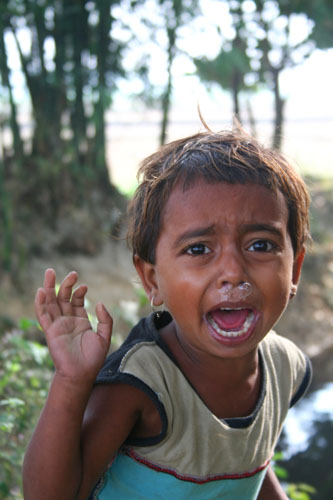
Sign Language (photos)
I ran into this construct recently in Dhaka's backwaters: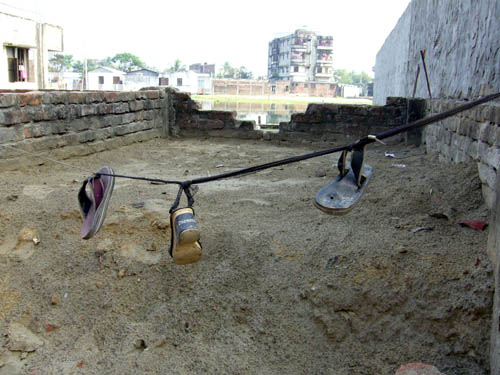
I was told that it was sign language for this:
Cow Talk in Old Dhaka
I went to old Dhaka to pick up hard-to-get bicycle parts, then chatted with some locals. Now that we are past Ramzan people's thoughts are on Korbani Eid (when an animal is sacrificed) coming up in two months. The Korbani markets (for buying the sacrificial animals) will begin in earnest in another month, but cow talk has already started in old Dhaka.
So what are popular animals, I asked. "Cows and Khasis, of course", was the answer, "and the rare BhuTTi cow occasionally." BhuTTI cow? (Is this guy pulling my leg?) "It is a small cow, looks very nice, only so high (his hand is at the knees). They fetch a premium price because they are so rare."
Inevitably, talk of prices. "Last year a cow sold for Tk 220,000." Wow, I said, that's pretty high. "It was a big cow," he said, "and beautiful. Very meaty. You could not feel one bone on any part of its body from the outside." How much meat would it yield? "250-300kg, easily." What was it fed? "Better food than humans! Sacks of corn and other good stuff." Who bought it? "Some local commissioner (politician). Used to be only Chittagong merchants could afford these expensive cows, but now there are rich politicians and merchants everywhere."
This Sumo cow had led quite the pampered life. "It had a room of its own. One person was there just to clean up after it all day." And the Dhakaiya finale: "The owner of this cow did not want it to be bitten by mosquitoes, so it slept under a mosquito net every night."
Bicycling Tips for Dhaka
I have finally gotten the hang of bicycling on Dhaka streets. Here are some guidelines I find useful.
Since Dhaka streets are prone to traffic jams, it is best to be flexible about destinations and times. Even better, try not to have a destination at all. Because if you have a firm destination in mind, then all other cars, busses, trucks, CNGs, rickshaws, motorcycles and pedestrians will simultaneously decide to go to the same place. Thus none of you will get there in the foreseeable future.
For bicycling purposes, street and footpath are interchangeable. In fact, footpath is preferable. Think about it. Unlike a nasty "Tata Mahindra" bus, no matter how hard a pedestrian runs into you, or you into them, they cannot crush your bones.
Also, using the footpath makes you adaptible. If your progress towards unknown destination stops due to a jam, you can keep moving by switching to a footpath.
Always wear a helmet. This will make sure you get the attention you deserve. Note however people are not staring in admiration of your impeccable safety standards. They are wondering how mad you are to be wearing this gizmo on your head on a hot day as sweat streams down the sides of your face.
Wear those zip-off-leg pants. Then open the front of the zip so your knee pops in and out in sync with pedaling. This provides much-needed air- conditioning your body. Also, those wondering about your sanity will stop wondering and avoid you.
Use a bell liberally. The soothing sound provides a musical counterpoint to the ongoing concerto for car and bus horns. The preferable spot to use the bell is on the footpath, when you are right behind a pedestrian. As a bonus, you will see their jumping and dancing skills.
For safety, use buffers when crossing or turning in insanely busy streets or roundabouts. Buffers are other pedestrians, bicycles and rickshaws which are crossing the street at the same place as you, but are closer to the approaching traffic. So if busses are coming from your left, your buffers should be crossing the street on your left. Thus, if a runaway bus cannot stop in time for your crossing, hopefully the collision with your buffer will stop it before it hits you.
Although it is sometimes tempting to go slow and savor the noise and fumes - I mean, peace and greenery - try to maintain a good pace. There is nothing more embarrassing than being left in the dust by a thin rickshaw-wallah carrying two overweight parents and a kid while you amble away on your fancy foreign made bicycle wearing that helmet.
Speaking of rickshaws, another great way to make friends with them is to follow one carrying many jute sacks full of rice. At an opportune moment - eg, when it is taking a turn and its balance is compromised - rear-end it firmly. Be sure you have a quick escape route before attempting this maneuver. Observe avalanche of the sacks from a safe distance.
If traffic heading in your opposite direction is completely stopped while you are breezing along, you can make many more friends my smiling and waving at the stuck people as you pass them. Loudly sing "Pichdhala ei pothTare Bhalobeshechhi" for extra effect. (Translation: Oh how I love this paved road!)
Us Banglas take our expectoration seriously. Try to anticipate when a person near you is going to spit, clear phlegm or throw pik (the red stuff resulting from chewing betel leaf) and which direction they will aim. Sometimes you will hear a throaty warning signal, but they can also strike silently. Avoid being in the same spot at the same time as flying expectorant.
Along the same lines, exercise caution when near a bus - specially a long distance one with open windows. Sooner or later someone will hurl through a window. Try not to get any on yourself. Double decker busses are even more dangerous. Aren't you glad you are wearing that helmet?
Never assume that just because you are on the left side of the road, other vehicles on the same side are headed in the same direction. Every 11th bicycle, 14th rickshaw and 7th motorcycle is headed wrong-way. No, they did not spend many years in America and think it is ok to drive on the right side. Actually I don't know why they do it - for shortcut purposes?
Be extra careful around traffic policemen with big sticks. They can become excited unexpectedly. Excited traffic police swing their sticks wildly. Try not to get your nose smashed in.
Delay your normal morning shower until after the bike ride. If you need a grey shirt, wear a white shirt during your ride and find an older bus spewing out black smoke. Follow this bus for a few minutes.
When you are getting tired of waiting to cross the road, never underestimate the power of stepping in forcefully in front of a moving vehicle. This is the only way to make them stop. Hopefully the buffer you have kept on your left will help. But if not, be brave. And if the vehicle doesn't stop - hey, you did leave your life insurance policy with your SO before leaving home, didn't you?
Gopal Bhaar and the Mobile Toilets
This article caught my attention today. It should be a big help for long-suffering denizens of Dhaka, although the number of toilets, 50, seems miniscule for 10 million people. Kudos to those who will make it happen.
http://www.thedailystar.net/2006/07/12/d607122503137.htm
But Tk.5 for defecating and Tk 2 for urinating? Reminds me of the old Gopal Bhaar story. Is someone going to be standing with a big stick to beat them up if they try to cheat?
Given our penchant for creating distinctions between people based on class, is there going to be a VVIP model, a VIP model and a Business and Economy model? The mind boggles at the possibilities.
And you know those signs on the back of cars here, things like, "Engaged in Important Export Duty", "Under Land Ministry", "Belongs to the Legal Counsel for the XX Minister", and the ubiquitous "Press"? Are we going to have similar signs for the potties? What will they say?
What would one advertise? Let's see... perfumes? lungis? Pepto-bismol? Or Ishobguler Bhushi?
Is there an exhaust-free CNG model in the works?
(Gopal Bhaar - the court jester for King Krishnachandra - story goes like this: one day a sentry arrived at Gopal's house and sat down to defecate on his lawn. Gopal ran out of the house and asked him to stop. The sentry said, "The King has ordered that I s**t on your lawn - so what can I do? Neither you nor I can disobey a king's direct order." Gopal asked him to wait a second, went inside the house and returned with a big stick. Then he positioned it like a baseball bat over the sentry. The sentry said "What are you doing?" Gopal said "The Kind only ordered you to s**t and said nothing about urinating. So if you urinate on my lawn while carrying out your assignment, I will kill you. Mutechho ki morechho." And so the sentry gave up and left. )
Unusual Agro Products
Agriculture is a thriving sector in Bangladesh. I have heard of some unusual agricultural products, including jackfruit seeds exported to Japan, and a syrup made from "Khejurer Rosh" - the sweet fluid extracted from Date trees.
Here is another one that was advertised in the paper yesterday - locally produced camel milk! (or is it !!!)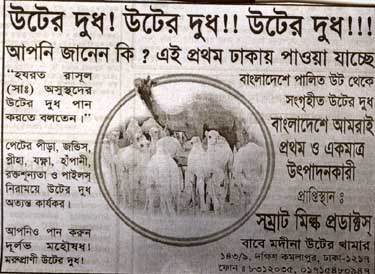
Driving in Dhaka
During my first few weeks in Dhaka, I was constantly stressed by the driving. I mostly relied on a driver, but was worried he was going to hit someone or something. Amazingly, nowadays I am relaxed in the car.
Some unwritten rules I have gathered (remember, you drive on the left here):
If you are at an intersection and want to turn right, it is best to be on the leftmost lane and swerve all the way to the right at the last possible moment. This helps keep everyone awake and provides free brake-check for parties on the right.
Rickshawallahs will not brake unless faced with a situation where the cost of not braking is significantly higher than the cost of braking. One such situation is a policeman with a big stick. Impending collision with a speeding car does not constitute a reason for a rickshawallah to brake. After all, it is easy for the car driver to brake and resume, but it is much harder for the rickshawallah to do that.
If you are a CNG driver, then the amount of arrogance you show while saying "No" to a prospective passenger's trip request should be directly proportional to how exhausted/sweaty/pitiful the passenger looks.
If you are a bus driver, nothing will dare get in your way. Do as you please.
Honking is an act of courtesy. You should honk whenever there is the remotest chance that the person (or vehicle) in front of you is unaware of you. Sometimes you should honk to make sure your horn is working. You should do this preferably between 2am and 4am.
If you are near a pedestrian overpass, you should be really watchful for pedestrians. Whenever they see an overpass, Bangladeshis have the curious need to cross the road. Since it is easier to dash in front of speeding cars and jump over traffic islands than it is to climb the overpass, most people will opt to get in the way of your car. The govt should have built overpasses for the cars at major pedestrian intersections in order to save the pedestrians so much inconvenience.
Hartal = Bike-to-work day?
Today is a hartal day so I biked to work. It's about 6 km from my house to the office and it took me 30 minutes.
Since the streets were reasonably empty, I breathed only an acceptable amount of fumes. The lowlight was when I got stuck behind one of those ancient "murir tin" busses. That stuff coming out of their exhaust is noxious!
I noticed at the outset the rear tire was low on air, so I tried to find one of those roadside stands where the rickshaws get their tires pumped. The first one I found had to use an adapter of sorts to fit his pump into the tire of the Schwinn hybrid. When he finished and disengaged the adapter, he must have let out some air, because the tire did not look that much better. While I was biking and searching for another pump at the roadside stands, I saw many shoe-polishers, couple of "juta-shelais" (cobblers) and even one guy who had laid out a shaving brush and assorted shaving paraphernelia. Eventually I found another pump, but he said he could not do it, and I needed a "car pump". I asked a Rickshawallah, is there a pump place nearby, to which he nodded and said over there, pointing to nowhere in particular.
And so it went. But I got to work ok.
The only place with signs of trouble was in Mohakhali where some serious looking men were sitting in the middle of the street, wearing punjabis, and looking solemn. They were surrounded by the police, who looked like they were protecting the sit-inners. About 5 yards down the road, there were broken bricks and rocks on the street. Further on, saw broken glass so some car or bus must have been attacked.
Another Hartal Day
Today is another half-day hartal. I took a rickshaw to work.
I don't know what happens to these rickshawwallahs on hartal days. Finding the streets free, they go berserk and think they can pedal the rickshaws at any speed they want. Perhaps it is the exhilaration of freedom. My rickshaw almost ran into five people, two children going to school, one taxi coming at a right angle, couple of thela-garis, one van-gari, one tiny bus carrying soft drinks and several tempos with terrified people dangling from the back. I lost count of how many potholes he ran over without slowing down. No doubt I will be sore from this and my blood pressure is probably still high from the tension.
Maybe I will bike to work the next hartal.
courtesy by...
SAGAR RESTUARANT
 |
Sagar Restaurant offers an extensive choice We provide 100% halal meat.of traditional Bangladeshi, Pakistani and Indian cuisine together with new mouthwatering recipes, but if you have a preferred dish that isn't on the menu, please don't hesitate to ask the management who will be more than happy to have our chef specially prepare it for you. |
Jamaica, New York 11432
PHONE: 718-298-5696
718-657-2855
718-213-4338(for catering only)
Web Site: www.sagarfood.com


